New Publication
ENSO Disruption in 1700
Unexpected ENSO Behavior around 1700 CE
Posted by Jim Stagge on July 11, 2025
Access the paper: Disruption of Drought Teleconnections Between ENSO-Influenced Regions Around 1700 CE
I am pleased to announce the publication of a collaborative paper led by former postdoc and new Assistant Professor, Max Torbenson. This study, “Disruption of Drought Teleconnections Between ENSO-Influenced Regions Around 1700 CE”, investigates anomalous behavior in the relationship between soil moisture reconstructed by tree-rings around 1700 CE across four regions that have a common connection to the El Nino Southern Oscillation (ENSO) teleconnection pattern.
Study Overview
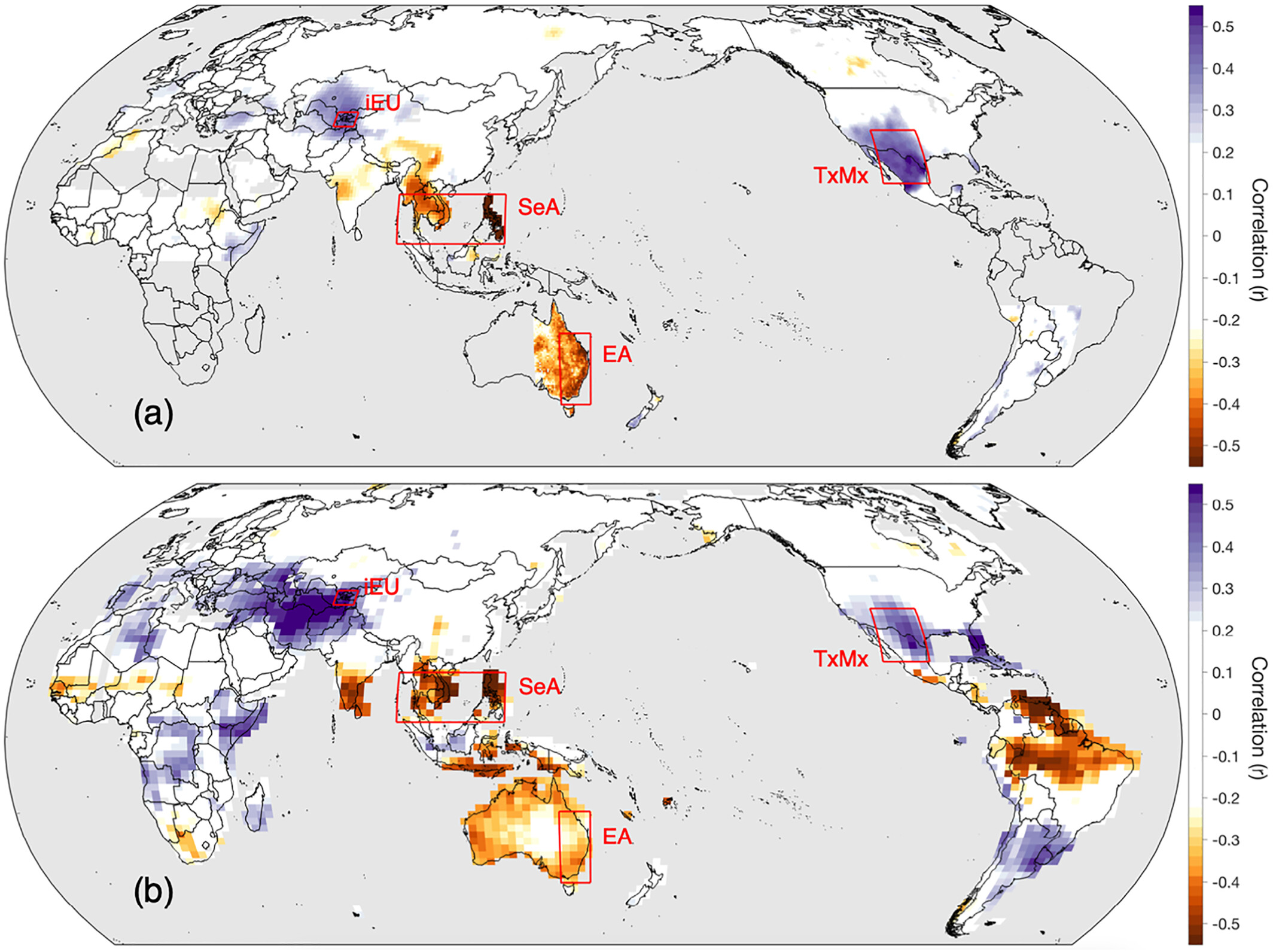
In this study, we considered four regions - southeast Asia, Kyrgistan, eastern Australia, and southwestern US/northern Mexico. These regions have a robust connection to winter ENSO during the modern period, with the North American and Kyrgistan regions becoming wetter during positive ENSO years and southeast Asia and eastern Australia becoming drier. During negative phases of ENSO, this pattern flips (Fig 1). Despite being 1,000s of miles apart, these regions tendd to act together because of the effect of ocean temperatures in the southern Pacific (ENSO) on atmospheric circulation.
Typical soil moisture correlation with ENSO, showing the four study reions in red boxes.
Using reconstructed soil moisture from these four regions, we found that the links between them have gone through periods of stronger or weaker correlations over the last 400 years (Fig 2). However, there was a dramatic breakdown of this inter-correlation in the early 1700s, which stands out as the only statistically significant disruption of the held pattern (Fig. 2).

Inter-relationships between regional tree ring-based soil moisture reconstructions. Pairwise correlations are shown to the left (a-f), while a summary inter-series correlation for all data is shown in the upper right (g).
Implications
- The disruption coincided with what is though to be one of the coldest periods in the last 1,000 years. While we can't conclude a causal link, this is intriguing for future work.
- Interestingly, climate models do not capture this breakdown, emphasizing the importance of proxy reconstructions.
- More work is needed to understand the causes of this ENSO teleconnection breakdown and what aspects are not being adequately modeled in climate simulations of the past.
Access the Publication
The full publication is available in [Geophysical Research Letters](https://doi.org/10.1029/2025GL115600).