
New Publication
Pre-Modern Nile Hydrologic Model
Pre-Modern Nile Model
Posted by Jim Stagge on April 15, 2026
Access the paper: Multi-Objective Calibration of a Pre-Modern Nile Hydrologic Model Using Recovered Records
I am pleased to announce the publication of our recent study titled Multi-Objective Calibration of a Pre-Modern Nile Hydrologic Model Using Recovered Records, which presents a breakthrough in modeling one of the world’s most complex and historically significant water systems: the Nile River Basin. Led by Irenee Munyejuru, a PhD candidate in the Stagge Lab, the research successfully calibrates a basin-scale hydrologic model that simulates the Nile’s “near-natural” flow conditions before the era of major modern reservoirs.
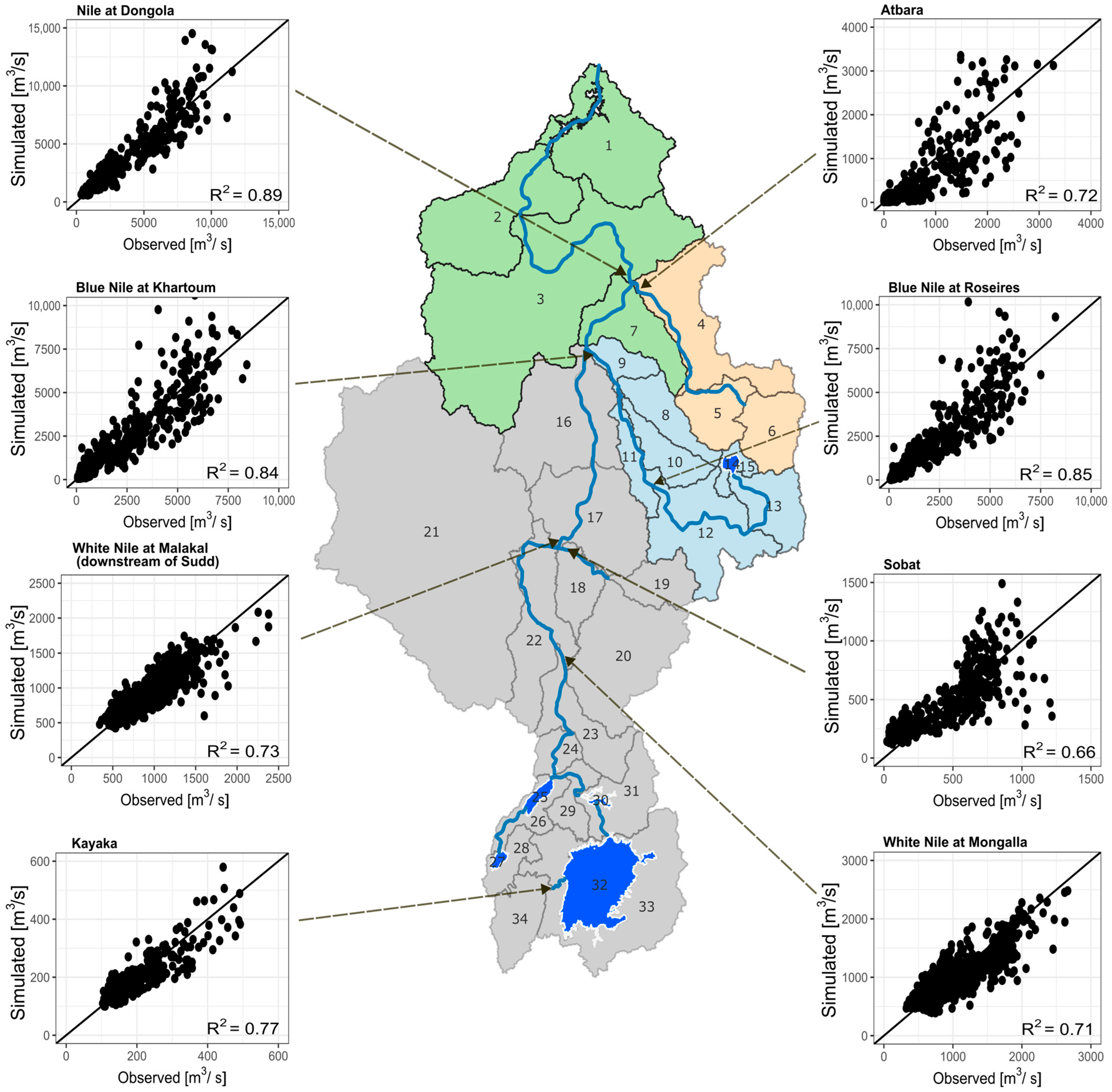
Comparison between observed and simulated discharge at different locations across the basin. Watershed colors and numbers are identical to Figure 1 and represent the White Nile, Blue Nile, Atbara, and main Nile.
Solving a Hydrologic Puzzle
The Nile River Basin (NRB) presents unique challenges for hydrologists. Its flow is dramatically altered by vast networks of lakes and wetlands that act as natural buffers, significantly delaying travel times and increasing water losses through evaporation. Until now, capturing these dynamics across the entire basin has been difficult due to sparse observational records and the interference of modern infrastructure.
We addressed these challenges by implementing the GR4J rainfall-runoff model within the Raven modeling framework. By discretizing the basin into 34 sub-watersheds and incorporating specialized submodels for lakes and wetlands, the study permits a detailed look at the river’s natural response to climate inputs.
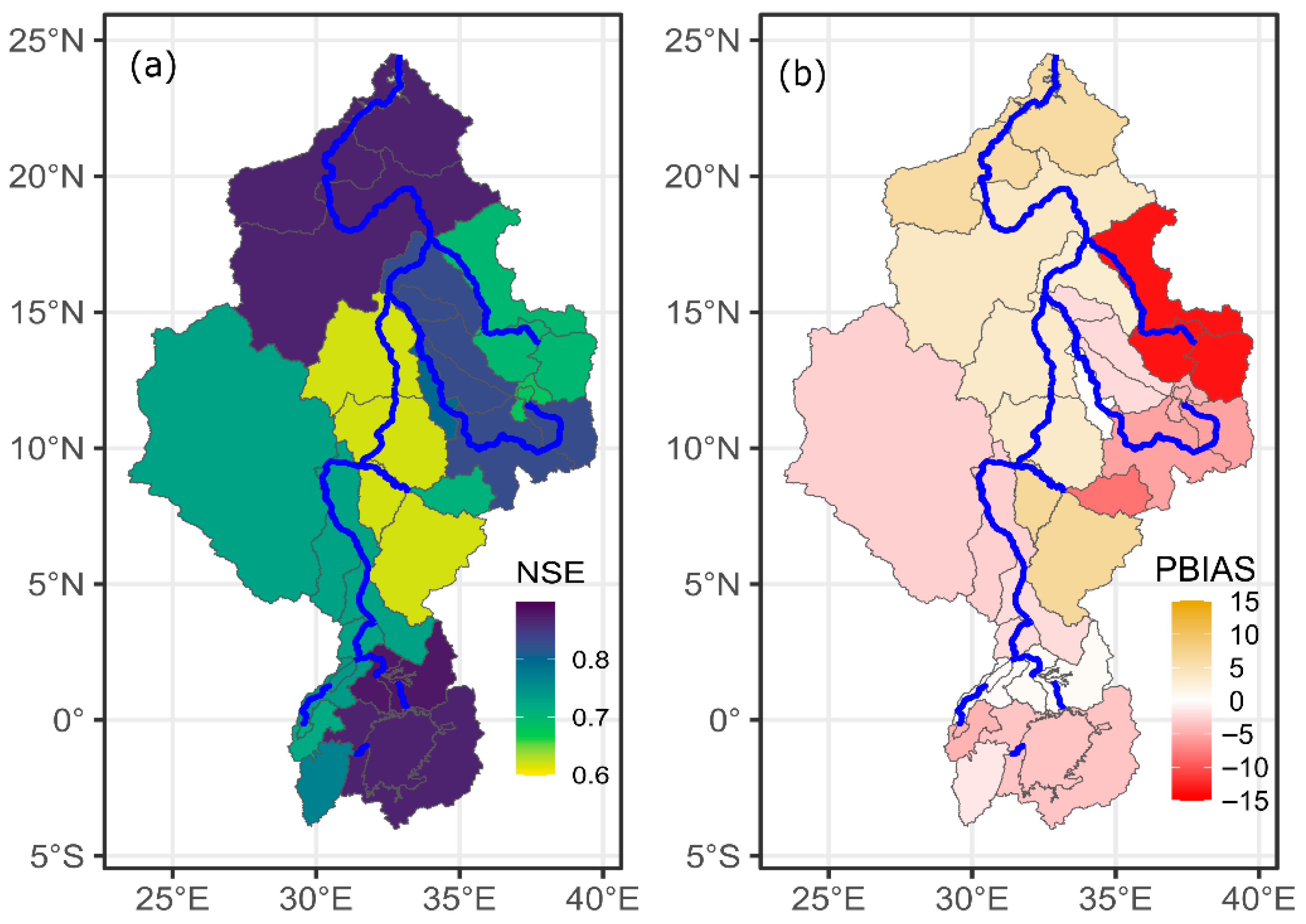
Model skill measured by (a) Nash–Sutcliffe Efficiency (NSE) and (b) Percent Bias (PBIAS) for each sub-watershed.
Harnessing Historical Data
To overcome a lack of calibration data, the study combined modern data from the Global Runoff Data Centre (GRDC) with meticulously recovered and digitized historical records.
Key Findings
- Pre-Modern Focus: Reconstructs the river as it existed for centuries, enabling studies into environmental history and climate archaeology.
- Wetland Model: Use of a physically logical fill-and-spill mode for the Sudd wetland.
- Calibration: At the Aswan outlet, the model achieved a Nash–Sutcliffe Efficiency (NSE) of 0.87 during calibration.
- Precipitation Sensitivity: A strong linear sensitivity to precipitation change in the Blue Nile, compared with a non-linear response in the White Nile.
- Temperature Sensitivity: A stronger effect of temperature change in the White Nile on downstream flow.
- Reproduces Shocks: Successfully simulated the 1960s "step-change" in Lake Victoria, a major regional hydroclimate disruption.
- Reproduces Low Frequency: Successfully replicates decadal scale trends and fluctuations
Read the full study
For more information and to access the full study, visit "Multi-Objective Calibration of a Pre-Modern Nile Hydrologic Model Using Recovered Records".
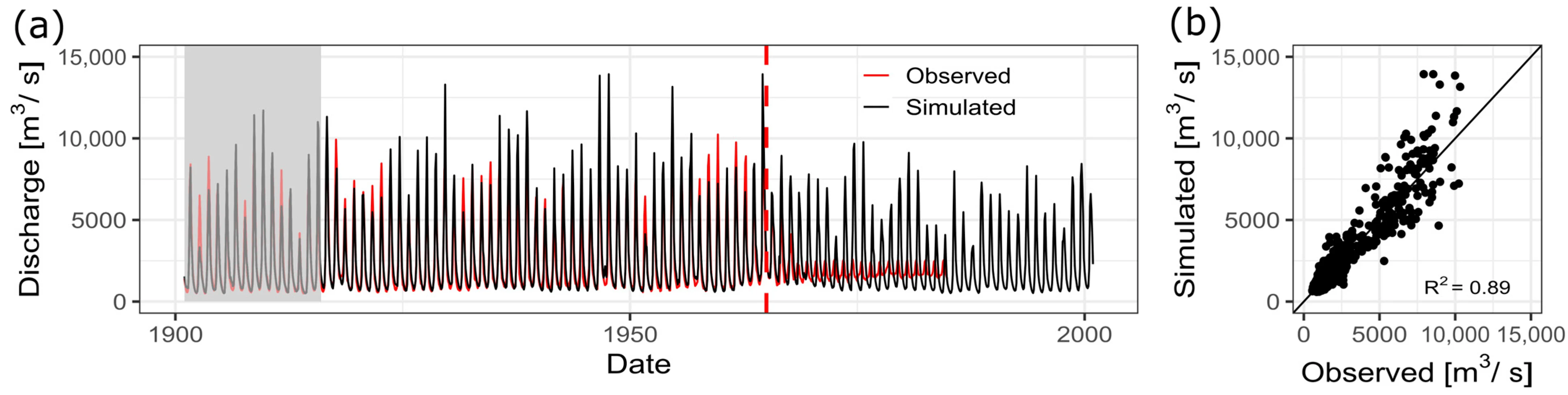
(a) Time series of monthly discharge at the Aswan for observed (red) and simulated (black). The shaded area represents the model spin-up period (1901–1915); the dashed red line in 1965 shows the construction of Aswan High Dam and its impact on the natural flow of the Nile River. At this outlet, calibration and validation were performed during the near-natural period between 1915 and 1964, showing good agreement. (b) Scatter plot for observed vs. simulated discharge between 1915 and 1964. NSE and PBIAS were 0.87 (0.80) and 6.1% (5.0%) during calibration (validation), respectively.
Abstract
Hydrologic models are instrumental in understanding the behavior of the Nile River Basin (NRB), yet their effectiveness is often limited by the basin’s complex hydrology and sparse observational records. This study applies a basin-scale hydrological modeling approach to simulate near-natural, pre-reservoir flow conditions in the NRB, while incorporating lake and wetland submodels. The basin was discretized into 34 sub-watersheds with an outlet at Aswan. The conceptual GR4J rainfall–runoff model was implemented within the Raven modeling framework, chosen for its parsimony and suitability for data-limited conditions. Multi-objective calibration used discharge data from the Global Runoff Data Centre (GRDC), supplemented by digitized historical records to improve spatial and temporal coverage. A stepwise calibration strategy was applied at 18 sites, focusing on pre-reservoir periods to capture natural flow dynamics. The calibrated model reproduces observed discharges with high skill. At the Aswan outlet, Nash–Sutcliffe Efficiency (NSE) values were 0.87 (calibration) and 0.80 (validation), with percent bias (PBIAS) values of 6.1% and 5.0%, respectively. Model performance was strongest in the Blue Nile, White Nile headwaters, and the Nile main stem. The model also successfully simulated the hydrological step-change observed in Lake Victoria during the 1960s, underscoring its robustness in simulating regional hydroclimate disruptions. This calibrated model enables reconstruction of historical Nile discharge and simulation of past hydrologic disturbances, including those driven by major volcanic eruptions over the past millennia.
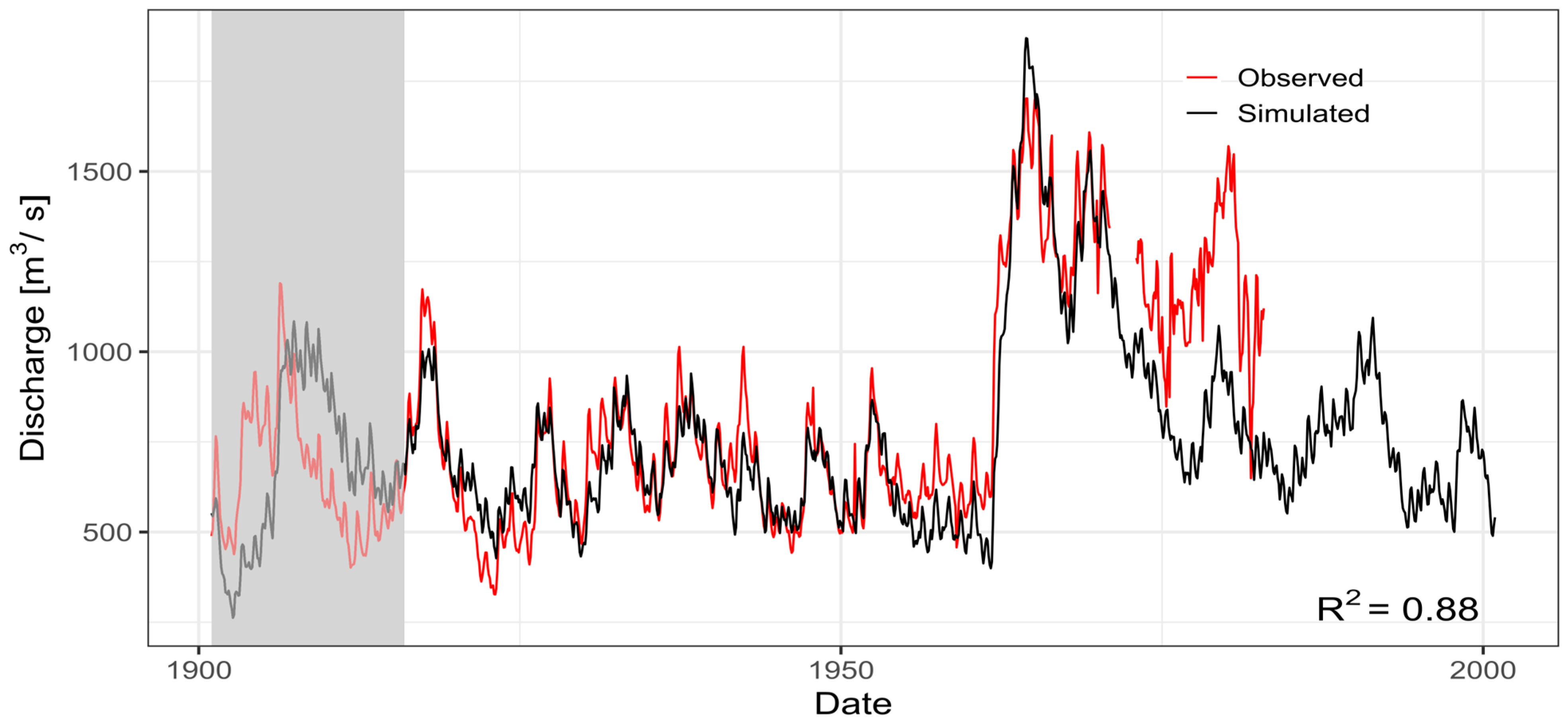
Lake Victoria: simulating regional disruption in the 1960s. Observed (red), simulated (black) and model spin-up period (shaded area).